


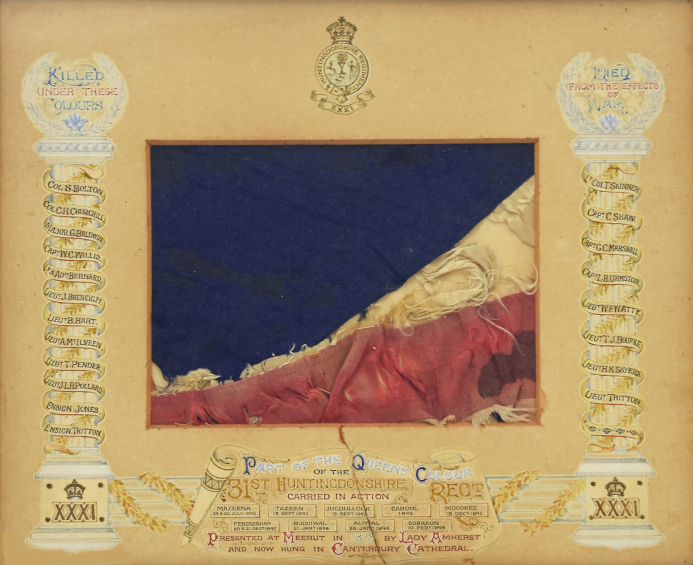
This is a piece of the Queen’s Colour which travelled with the 31st Regiment of Foot during the First Anglo-Sikh War (December 1845 – February 1846). The 31st Regiment of Foot later became part of the East Surrey Regiment, one of the PWRR’s forebears. The Regiment remembers the bravery of one of the 31st’s soldiers every 10th of February, on the anniversary of the Battle of Sobraon.
The Battle of Sobraon
The Battle of Sobraon, on the 10th of February 1846, was the final battle in this short, intense war. Ensign Charles Tritton carried this colour into the battle. Both Tritton and the ensign carrying the Regimental Colour were killed. When the battle seemed lost, Sergeant Bernard McCabe grabbed the Regimental Colour, climbed to the top of the Sikh’s encampment under fire, and planted the colour there for everyone to see. This gave the 31st Regiment of Foot the inspiration they needed to break through the Sikh defence and led to a British victory.
The PWRR remember McCabe’s bravery every year on the anniversary of the battle. Each Battalion appoints a Sobraon sergeant. The sergeant receives the Regimental Colour from the Officer’s Mess and places it in the Warrant Officers’ and Sergeants’ mess for the day.
The Life Cycle of a Colour
Both of the 31st’s colours hung in tatters when they returned to England. In the Illustrated London News, they were described as “torn to shreds from the storm of grapeshot through which they were victoriously borne, and stained with the blood of the Ensigns who were killed carrying them”. The Regiment kept this fragment of the Queen’s Colour and framed it, to display it in one of their messes.
The rest of this colour was ‘laid up’ at Canterbury Cathedral. It remains on display there as part the 31st Sutlej Testimonial. Colours are never destroyed once they are too old or damaged to use. Instead, the army ‘lay up’ the colours in places of worship and museums. The colours stay hung for as long as possible. When they reach a state of complete disrepair, the colour must be buried on consecrated ground.
Regiments stopped taking their colours into battle in 1881, but each regiment still holds a set of colours. Each battalion receives new colours about once every thirty years.

