... whilst in command of the battalion scouts in advance of the vanguard, he was held up by the enemy but succeeded in rallying some troops who had lost their leaders, and in organising a firing line he showed great skill and initiative throughout the operation
Military Cross Citation, London Gazette, 4th February 1918
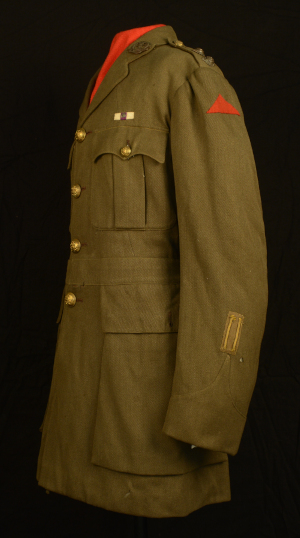
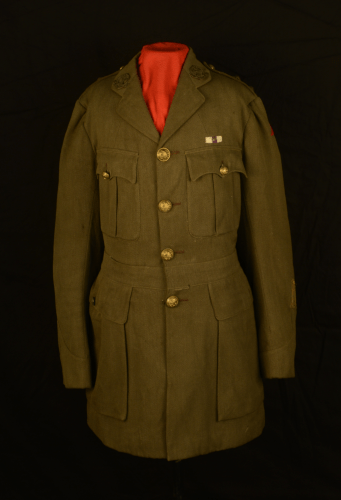
This uniform belonged to Lieutenant Thomas Deeves. Thomas, who served in the 16th (Service) Battalion (Public Schools) of the Middlesex Regiment, earned the Military Cross twice over for his bravery in battle.
Deeves was born in County Tipperary, in Ireland, in 1893. Despite the name of his battalion, he did not go to a public school. Before the outbreak of war, Deeves worked for the civil service in London. He joined the 1/15th London (Civil Service Rifles) Regiment as a private soldier in 1915; he joined the Middlesex Regiment as an officer in 1917. Deeves completed his officer training at the same time as Lieutenant Walter Tull.
Reading Deeves's Uniform
A soldier’s uniform can tell us a huge amount about his experience in the army. Thomas received many other medals, but only his Military Cross with Bar medal ribbon sits on this uniform. The rosette sewn onto the medal ribbon shows Thomas won the double award.
The red triangle at the top of the left sleeve on Thomas’s uniform is a division flash. His battalion formed part of the 29th Division. Closer to the wrist, Thomas wore two ‘Wound Stripes’. Injured soldiers were awarded two inch pieces of Russian gold braid to wear on their sleeve. In 1916, Thomas received a finger injury which finished his career in the Rifles. He retrained as an officer and joined the Middlesex Regiment.
Thomas was injured again at the Battle of Cambrai, during the second exploit which earned him a Military Cross.
He set a splendid example under heavy machine gun fire, and, though wounded, he continued to encourage his men by his splendid example and determination.
Bar to Military Cross Citation, London Gazette, 26th March 1918
A Life Changing Injury
On the 30th of November, 1917, an airplane machine gun struck Thomas in the midst of battle. The bullets shattered his left shoulder blade, and Thomas was left for dead in a farmhouse. Two days later, before soldiers took him away to be buried, a passing doctor checked his pulse. Somehow, Thomas was still alive.
Thomas first spent two days in a ‘No Hope Ward’, where badly wounded soldiers lived their last days in comfort. After it became clear he was not going to die, Thomas finally received treatment from a doctor. Thomas endured over thirty operations on his left arm, but finally asked doctors to amputate it two and a half years later.
After the war, Thomas married and returned to the civil service. He served as Assistant Secretary of Food during the Second World War, and then worked for the Foreign Office. For his long service for his country, Thomas earned a CBE and became a Companion of the Order of St Michael and St George. He also attended Queen Elizabeth II’s coronation.